Most Goals in Football History: Official Rankings and Records
Goals are the lifeblood of football. They turn matches into legends, break stadiums out in thunderous roars, and immortalize the players who score them. Throughout the decades, fans have engaged in passionate arguments over which player deserves the ultimate crown of being the ultimate goal machine. When discussing the beautiful game, one question consistently ignites passionate debate among fans, pundits, and football historians alike: who has scored the most goals in football history?
While the answer might seem straightforward at first glance, the reality is deeply complex. The history of the sport spans over a century, during which record-keeping standards have varied dramatically. Different eras featured varying match densities, regional leagues, and contrasting rules. Today, we look at the official rankings, analyze the statistical databases, and explore the legendary careers of the players who have written their names in gold.
Table of Contents
- 1. The Evolution of Statistical Records for Most Goals in Football History
- 2. Official Rankings of All-Time Goalscorers
- 3. Deep Dive into the Top Goalscorers
- 4. Comparing Modern Era vs. Golden Era: Most Goals in Football History
- 5. The Official Databases: Who Validates the Most Goals in Football History?
- 6. Frequently Asked Questions on the Most Goals in Football History
- 7. Conclusion: The Legacy of Goalscoring Greatness
The Evolution of Statistical Records for Most Goals in Football History
To understand the race for the most goals in football history, we must look at how statistics are compiled. Historically, football did not have a central, unified global database to track every single goal scored across the world. Instead, regional football associations, local sports newspapers, and individual club historians kept records. This lack of centralized tracking is the main reason why various historical figures are surrounded by statistical discrepancies.
For instance, during the early to mid-20th century, many matches were classified as unofficial, semi-professional, or regional exhibition games. Players like Pelé and Josef Bican frequently participated in friendly tournaments, military team matches, and reserve-tier leagues. Consequently, statistical organizations have worked tirelessly to filter out these matches to establish a highly reliable ranking based strictly on “official” games.
Today, researchers categorize matches into two main types to resolve these differences:
- Official Matches: These include top-tier national league matches, domestic cup competitions, official continental club tournaments (such as the UEFA Champions League or Copa Libertadores), and senior international matches played for a recognized national team.
- Unofficial Matches: These include club friendlies, pre-season exhibition tours, amateur-level matches, charity games, and reserve team fixtures.
Because of these distinctions, we see a significant gap between “official” career tallies and “all matches” tallies. Therefore, when compiling the list of the most goals in football history, contemporary sports journalism almost exclusively relies on official matches to maintain consistency and fairness across different generations.
Official Rankings of All-Time Goalscorers
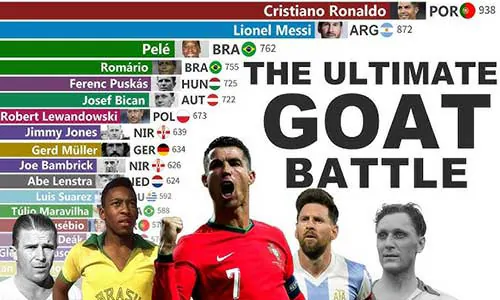
The following table provides a clear breakdown of the top players with the most goals in football history. This list is compiled using validated statistics from recognized bodies like the Rec.Sport.Soccer Statistics Foundation (RSSSF) and the International Federation of Football History & Statistics (IFFHS). The numbers reflected here represent senior-level official goals scored for both club and country.
| Rank | Player | Active Era | Primary Country | Official Goals | Official Matches |
|---|---|---|---|---|---|
| 1 | Cristiano Ronaldo | 2001–Present | Portugal | 973 | ~1,295 |
| 2 | Lionel Messi | 2003–Present | Argentina | 910 | ~1,155 |
| 3 | Josef Bican | 1931–1955 | Austria / Czechoslovakia | 805+ (Up to 950) | ~624+ |
| 4 | Romário | 1985–2009 | Brazil | 772 | 994 |
| 5 | Pelé | 1956–1977 | Brazil | 762–770 | ~840 |
| 6 | Ferenc Puskás | 1943–1966 | Hungary / Spain | 746+ | ~754+ |
| 7 | Gerd Müller | 1963–1981 | West Germany | 734 | 793 |
| 8 | Robert Lewandowski | 2005–Present | Poland | 685+ | ~950+ |
Deep Dive into the Top Goalscorers
Cristiano Ronaldo: The Undisputed Leader of Most Goals in Football History
When Cristiano Ronaldo made his professional debut with Sporting CP in Portugal, few could have anticipated that he would eventually conquer the world of football. Ronaldo has systematically redefined consistency, longevity, and physical conditioning. Over a career spanning more than two decades, he has scored a staggering 973 official goals for both club and country.
Ronaldo’s extraordinary journey to the pinnacle of the most goals in football history has seen him play across four major leagues: the Portuguese Primeira Liga, the English Premier League, the Spanish La Liga, the Italian Serie A, and currently, the Saudi Pro League with Al Nassr. His peak goalscoring years occurred during his time at Real Madrid, where he netted an unbelievable 450 goals in just 438 official appearances—a ratio higher than one goal per match.
In addition to his club achievements, Ronaldo is the all-time leading goalscorer in men’s international football. Representing Portugal, he has scored over 143 official goals, including critical strikes in the UEFA European Championships, FIFA World Cups, and the UEFA Nations League. As Ronaldo approaches the latter stage of his career, his determination remains as strong as ever, with his sights firmly set on reaching the unprecedented milestone of 1,000 official career goals.
His success is driven by a unique combination of exceptional athleticism, elite positioning, and aerial dominance. From his early days as a fleet-footed, flashy winger at Manchester United to his evolution into a clinical central striker, Ronaldo has shown a remarkable ability to adapt his game to stay at the very top of world football.
Lionel Messi: The Playmaker Dominating the Most Goals in Football History List
While Ronaldo has built his career on pure athleticism and clinical finishing, Lionel Messi has enchanted the footballing world with his incredible dribbling, vision, and extraordinary playmaking ability. Despite often dropping deep to build up play, the Argentine magician has amassed over 910 official career goals, securing his position as one of the elite names in the most goals in football history.
Messi spent the vast majority of his career at FC Barcelona, where he became the club’s all-time top scorer with 672 official goals. During his historic tenure in Catalonia, he broke numerous records, including the mind-boggling feat of scoring 91 goals in a single calendar year (2012)—a record that may never be broken. Following successful spells at Paris Saint-Germain, Messi moved to Major League Soccer (MLS) with Inter Miami, where he continues to add to his legacy.
On the international stage, Messi has achieved legendary status. He led Argentina to victory in the 2021 Copa América, the 2022 FIFA World Cup, and the 2024 Copa América. His international tally stands at 116 official goals, making him the highest South American goalscorer in international football history.
What makes Messi’s goalscoring so impressive is his high efficiency. He has consistently registered incredible goal-to-game ratios throughout his career, often requiring fewer matches to reach major milestones compared to his peers. His playstyle relies on intelligence, sudden bursts of acceleration, and a legendary left foot that can find the back of the net from almost any angle.
Josef Bican: The Historical Benchmark for Most Goals in Football History
For decades, the name of Josef “Pepi” Bican was a myth whispered among football historians. Born in Vienna in 1913, Bican was an Austrian-Czechoslovakian striker who dominated European football during the 1930s and 1940s. He is widely recognized as the historical standard-bearer for the most goals in football history.
Bican was exceptionally fast, reportedly capable of running 100 meters in 10.8 seconds—an elite athletic speed for his era. This blistering pace, combined with his ability to shoot with equal precision using both feet, made him a nightmare for opposing defenders. He played his most prolific club football for Slavia Prague, where he scored an astounding 591 official goals in just 301 appearances.
According to research conducted by the RSSSF, Bican scored at least 805 official goals in competitive matches. However, some historical estimates that include regional, reserve, and wartime matches push his tally to over 950 official goals. Because of the challenging circumstances of World War II and fragmented records from that period, the exact final tally remains a subject of minor debate, but his status as one of football’s greatest goalscorers is unquestioned.
Pelé: The Brazilian King and His Legendary Tally
No discussion about football greatness can be complete without mentioning Edson Arantes do Nascimento, universally known as Pelé. The Brazilian King is widely considered by many as the greatest footballer to ever walk the earth. During his legendary career, Pelé won three FIFA World Cups (1958, 1962, and 1970)—a record that remains unmatched to this day.
Pelé spent nearly his entire club career at Santos FC, where he scored 643 official goals in 659 competitive appearances. He later moved to the United States to play for the New York Cosmos, helping to popularize soccer in North America. While Pelé’s official goal count is registered between 762 and 770 goals by strict modern criteria, he famously claimed to have scored 1,283 goals throughout his lifetime.
This massive difference of over 500 goals comes from Pelé’s inclusion of friendly matches, national military team matches, and high-profile international tours. During the 1960s, Santos travelled across Europe and Africa to play exhibition games against top-tier European teams. These matches were highly competitive and drew massive crowds, but because they were technically friendlies, they are excluded from modern official career counts. Regardless of how one views the statistics, Pelé’s impact on the sport and his incredible goalscoring prowess are etched forever in football history.
Romário: The Master of the Penalty Area
Romário de Souza Faria, known simply as Romário, was one of the most clinical, cold-blooded finishers the sport has ever seen. The Brazilian forward was the spearhead of Brazil’s 1994 FIFA World Cup-winning team and enjoyed a highly successful club career across South America and Europe.
Romário played for prestigious clubs such as Vasco da Gama, PSV Eindhoven, and FC Barcelona. He was famous for his low center of gravity, incredible acceleration over short distances, and supreme composure inside the penalty box. Officially, Romário scored 772 goals in 994 matches. Like Pelé, Romário actively chased his personal milestone of 1,000 career goals, which he celebrated reaching in 2007 by counting various youth, reserve, and friendly matches. In terms of recognized official matches, he remains firmly in the top five of the all-time goalscoring rankings.
Ferenc Puskás: The Mighty Magyar
Ferenc Puskás was the leader of the legendary Hungarian national team of the 1950s, known as the “Mighty Magyars.” Puskás possessed a legendary left foot that was both incredibly powerful and pinpoint accurate.
Puskás scored 358 league goals in Hungary for Budapest Honvéd before moving to Spain to join Real Madrid at the age of 31. Despite his age and doubts about his physical fitness, Puskás went on to score 242 goals in 262 matches for the Spanish giants, winning multiple European Cups. With 746+ official career goals, he remains a symbol of pure goalscoring excellence, and FIFA’s award for the most beautiful goal of the year is named in his honor.
Comparing Modern Era vs. Golden Era: Most Goals in Football History
The Role of Rules and Match Densities in Most Goals in Football History
When comparing the achievements of modern superstars like Cristiano Ronaldo and Lionel Messi with historical legends like Josef Bican and Pelé, several important contextual factors must be kept in mind. Football has evolved dramatically over the decades, and each era presents its own unique set of challenges and advantages.
One of the most significant differences lies in the number of matches played per year. Modern elite footballers participate in an incredibly packed schedule. Between domestic leagues, cup competitions, the expanded UEFA Champions League, and frequent international fixtures, a top-tier player today can easily play 60 to 70 matches a year. This high frequency of competitive games gives modern players a distinct advantage in accumulating the most goals in football history over a long career.
However, playing so many games requires unprecedented levels of physical endurance. This is where modern sports science, nutrition, and advanced physical therapy play a vital role. Today’s players have access to elite recovery facilities, personalized diets, and advanced training regimes that allow them to extend their careers well into their late 30s and early 40s. In contrast, players of the golden era often played on poor quality pitches, with heavy leather balls, and faced highly physical, unchecked tackling from defenders without the benefit of modern referee protection or VAR.
Additionally, rule changes have shifted the balance between attackers and defenders:
- The Offside Rule: The liberalization of the offside rule over the decades has generally made it easier for forwards to find space behind defensive lines.
- Referee Protection: Stricter officiating and the introduction of yellow and red cards have protected creative players from career-ending tackles, allowing them to play consistently without fear of serious injury.
- Tactical Evolution: While modern defenders are highly disciplined and organized, older eras of football were often characterized by highly attacking formations, which sometimes resulted in much higher-scoring matches.
Consequently, the goalscoring achievements of both the modern and historical eras are equally remarkable in their own ways. The modern era demands relentless, year-round consistency, while the golden era demanded immense physical resilience under challenging conditions.
The Official Databases: Who Validates the Most Goals in Football History?
Because FIFA, the global governing body of football, does not maintain an active, daily updated historical archive of individual player goal records, the responsibility of validating the most goals in football history falls on independent statistical organizations.
The two most prominent and respected organizations in this field are:
- The Rec.Sport.Soccer Statistics Foundation (RSSSF): Established in 1994, the RSSSF is an international organization dedicated to collecting exhaustive statistics on football matches worldwide. It is widely considered the gold standard for historical football data, and its volunteers meticulously verify lineups, goalscorers, and match statuses.
- The International Federation of Football History & Statistics (IFFHS): Founded in 1984, the IFFHS is recognized by FIFA as an archive of football history. It regularly publishes rankings of top goalscorers, leagues, and clubs, applying strict criteria to ensure only top-level official matches are counted.
Through the tireless work of these organizations, football fans can access reliable, evidence-based data that cuts through the myths and folklore of the past. Therefore, when evaluating the most goals in football history, referring to RSSSF and IFFHS database records ensures that the statistics are grounded in documented historical facts rather than hearsay.
Frequently Asked Questions on the Most Goals in Football History
Who officially has the most goals in football history?
As of mid-2026, Cristiano Ronaldo holds the official world record for the most goals in football history, with 973 official goals scored for club and country. He is followed by Lionel Messi, who has scored over 910 official goals.
Did Pelé really score over 1,000 goals?
Pelé scored 1,283 goals throughout his life, which is recognized by the Guinness World Records. However, this total includes over 500 goals scored in unofficial friendly matches, exhibition tours, and military team games. In official competitive matches, Pelé’s tally is officially recorded between 762 and 770 goals.
Why are Josef Bican’s goal records debated?
Josef Bican’s official tally is widely accepted as 805 goals by FIFA. However, the RSSSF has identified up to 950 official goals in records that include reserve matches, regional tournaments, and unofficial wartime league fixtures. Because of incomplete data from the 1930s and 1940s, different statistical bodies apply varying criteria to his matches.
Do friendly matches count toward the official goal records?
No. Standard club friendly matches, pre-season exhibition tours, and charity matches do not count toward official historical goal totals. However, official international friendly matches played by senior national teams are recognized and counted by both FIFA and historical statistics organizations.
Who has scored the most international goals in football history?
Cristiano Ronaldo holds the record for the most international goals in men’s football history, with over 143 goals for the Portuguese national team. Lionel Messi is second with 116 international goals for Argentina.
Who has scored the most goals for a single club?
Lionel Messi holds the record for the most goals scored for a single club in football history, having netted 672 official goals for FC Barcelona between 2004 and 2021. He broke Pelé’s long-standing record of 643 goals for Santos FC.
Conclusion: The Legacy of Goalscoring Greatness
The race for the most goals in football history is a fascinating journey through time. It connects the pioneering icons of the early 20th century with the ultra-athletic modern superstars of today. While historical figures like Josef Bican and Pelé set the standard for generations, Cristiano Ronaldo and Lionel Messi have taken the sport to heights never seen before.
As Ronaldo and Messi continue to play in their respective leagues, they show us that greatness is not just about raw talent, but also about dedication, longevity, and professional discipline. Regardless of which player you support, we are living in a historic era for football statistics.
Who do you think is the greatest goalscorer of all time? Will Cristiano Ronaldo reach his dream of scoring 1,000 official career goals before he retires? Let us know your thoughts in the comments below, and don’t forget to share this article with your fellow football fans!