Football Formations Guide: From 4-4-2 to Today’s Tactical Systems
Football Formations Guide: From 4-4-2 to Today’s Tactical Systems in the FIFA World Cup 2026 Era
Football is a beautifully complex game where strategic genius often outweighs raw athletic talent. As fans and analysts eagerly look forward to the FIFA World Cup 2026, understanding the tactical frameworks that govern the pitch has never been more important. Football tactics are not static; they are a living, breathing evolution of space, movement, and physical capability. To truly appreciate how teams will set up at the FIFA World Cup 2026, we must trace the lineage of these systems, from traditional historical setups to today’s highly fluid, hybrid arrangements.
Whether you are a casual viewer trying to understand why your favorite team is struggling to score, or a dedicated student of the game looking ahead to international football’s biggest stage, this guide will break down the essential football formations. We will examine how we moved from the rigid lines of the past to the complex, space-oriented modern tactics that will define the global game in the coming years.
Table of Contents
- The Evolution of Tactics: From Classic 4-4-2 to FIFA World Cup 2026 Strategies
- The Classic 4-4-2: The Foundation of Modern Tactics
- The 4-3-3 Revolution: Tiki-Taka and Positional Play
- The Dynamic 4-2-3-1: Balance and Versatility
- The Resurgence of Three-at-the-Back: 3-5-2 and 3-4-3
- In-Possession vs. Out-of-Possession: Modern Fluidity Explained
- How Modern Formations Will Shape the FIFA World Cup 2026
- Key Tactical Trends to Watch in the FIFA World Cup 2026
- Tactical Comparison Table
- Frequently Asked Questions (FAQ)
The Evolution of Tactics: From Classic 4-4-2 to FIFA World Cup 2026 Strategies
To understand modern systems, we must first appreciate where they came from. In the early days of football, formations were heavily weighted toward attack. Systems like the 1-2-7 or the famous “WM” formation (3-2-2-3) dominated the pitch. However, as defensive organization improved, managers sought a balance between solidity at the back and threat upfront. As we prepare for the tactical showcases of the FIFA World Cup 2026, tracing this evolution reveals a constant battle between defensive structure and creative freedom.
The transition from highly structured, rigid positions to fluid, phase-dependent systems represents the biggest shift in modern coaching. Historically, players had strict designations. A left winger stayed on the touchline; a center-back rarely crossed the halfway line. Today, players are expected to be multi-functional. Consequently, modern formations are often dynamic shapes that change depending on whether a team has the ball or is defending.
This evolution is driven by the search for space. As defensive blocks have become more compact and physically disciplined, managers have had to devise increasingly clever ways to break them down. This historical battle of wits sets the stage for the highly sophisticated strategies we expect to see deployed by national teams worldwide during the upcoming tournament cycle.
The Classic 4-4-2: The Foundation of Modern Tactics
For decades, the flat 4-4-2 was the undisputed king of football formations, particularly in England and parts of Europe. It consists of four defenders, four midfielders, and two strikers. The beauty of the 4-4-2 lies in its simplicity and balanced coverage of the pitch. It creates natural partnerships all over the field: two center-backs working together, two central midfielders controlling the engine room, and two strikers threatening the opposition’s defensive line.
In this system, wingers are responsible for providing width and delivering crosses into the box, while the two strikers usually operate in tandem—often utilizing a “big man, small man” partnership. One striker acts as a target man to win aerial duels, while the second striker plays off him, exploiting the space behind the defense. Defensively, the 4-4-2 is exceptionally robust, forming two compact banks of four that are difficult to break through. While it has fallen out of favor as a primary attacking system, it remains a popular defensive low-block variation that teams might deploy at the FIFA World Cup 2026 to frustrate superior opponents.
Key Advantages of the 4-4-2:
- Excellent Pitch Coverage: Simple, clear defensive responsibilities make it easy for players to organize quickly.
- Strong Defensive Solidity: Two banks of four present a compact barrier, leaving very little space between the lines.
- Direct Attacking Routes: With two central strikers, teams can quickly transition from defense to attack using direct long balls or crosses.
The Downfall of the Flat 4-4-2:
Despite its historic success, the flat 4-4-2 fell out of favor at the elite level due to one major vulnerability: the midfield battle. When playing against a team with a three-man midfield, a two-man midfield in a 4-4-2 is easily outnumbered. Furthermore, modern defenders became adept at handling predictable, direct balls to two static strikers, forcing coaches to look for more dynamic alternatives.
The 4-3-3 Revolution: Tiki-Taka and Positional Play
As the rigid 4-4-2 began to struggle against teams utilizing three central midfielders, the 4-3-3 emerged as the tactical antidote. Popularized by Johan Cruyff’s Ajax and Barcelona, and later perfected by Pep Guardiola, the 4-3-3 focuses on domination of possession, triangular passing networks, and positional play.
The defining feature of the 4-3-3 is the midfield trio, typically composed of a defensive anchor (the “single pivot” or regista) and two creative central midfielders (the “interiors”). This setup naturally creates passing triangles across the pitch, making it much easier to retain possession and build attacks from the back. In attack, the wingers in a modern 4-3-3 often tuck inside as “inverted wingers,” opening up the wide spaces for overlapping full-backs. Many of the top nations competing in the FIFA World Cup 2026 will rely on this template as their primary structural starting point.
Key Components of the 4-3-3:
- The Single Pivot: A deep-lying midfielder who shields the defense, intercepts passes, and dictates the tempo of the game.
- Inverted Wingers: Wide attackers who cut inside onto their stronger foot to shoot or create, rather than staying wide to cross.
- The False Nine: A striker who drops deep into midfield to draw central defenders out of position, leaving space for wingers to run into.
By controlling the center of the pitch, teams playing a 4-3-3 can dictate the tempo of the match. However, this system requires highly technical players with excellent decision-making abilities. If the single pivot is isolated or pressed effectively, the entire system can struggle to transition from defense to attack, making tactical discipline paramount.
The Dynamic 4-2-3-1: Balance and Versatility
During the late 2000s and 2010s, the 4-2-3-1 became the most widely adopted formation in world football. It offers an exceptional blend of defensive security and attacking fluidity. By employing a “double pivot” (two defensive or box-to-box midfielders) in front of the back four, this system provides a secure shield against counter-attacks while freeing up four attacking players to create chances.
The heart of the 4-2-3-1’s offensive threat is the central attacking midfielder, often referred to as the “number 10.” This player operates in the pockets of space between the opponent’s midfield and defense, acting as the primary playmaker. Flanked by two energetic wide players and supported by a lone striker, the number 10 has multiple passing options at any given moment. This formation remains a highly popular template for teams competing in the FIFA World Cup 2026 due to its inherent balance and ease of transition.
Why the 4-2-3-1 remains highly popular:
- Double Pivot Protection: Having two deeper midfielders protects the central defense and allows full-backs to join the attack safely.
- Tactical Flexibility: It can easily transition into a defensive 4-4-1-1 or an attacking 4-2-4 depending on the game state.
- Creative Freedom: The central playmaker is insulated from heavy defensive duties, allowing them to focus on breaking down opposition defensive blocks.
Consequently, the 4-2-3-1 is often the go-to choice for managers who want to maintain tactical control without sacrificing offensive power. It accommodates various player profiles, making it highly adaptable for national teams with limited preparation time.
The Resurgence of Three-at-the-Back: 3-5-2 and 3-4-3
Tactics operate in cycles. As teams became adept at defending against single-striker systems, managers looked to the past to find a new advantage. This led to a major resurgence of three-at-the-back systems, such as the 3-5-2 and 3-4-3. This tactical framework will undoubtedly be a key tactical weapon during the FIFA World Cup 2026, offering unique structural challenges for opponents.
The key to any modern three-back system is the role of the wing-backs. These players must possess incredible physical stamina, as they are tasked with patrolling the entire length of the touchline. In possession, they push high and wide to act as traditional wingers, forming a five-man attack. Out of possession, they drop back alongside the three central defenders to form a highly secure five-man defensive block.
Modern Variations of the Three-Back System:
- The 3-5-2: Focuses on central midfield dominance and direct strike partnerships. It allows two strikers to press opposition center-backs while the midfield trio controls the center.
- The 3-4-3: Creates a highly potent front three, allowing wingers to occupy the half-spaces while wing-backs provide extreme width along the touchlines.
- Overlapping Center-Backs: An innovative modern trend where the outer center-backs in a back three make overlapping runs into the final third to overload wide areas.
By utilizing three center-backs, teams are much more secure against central counter-attacks and cross-heavy offenses. Furthermore, this system allows for excellent build-up play from the back, as the three defenders can spread wide across the pitch, making them incredibly difficult to press effectively.
In-Possession vs. Out-of-Possession: Modern Fluidity Explained
To truly understand how elite teams play today, we must look beyond static formation numbers. Modern football is defined by fluid phase changes. A team’s lineup on paper rarely reflects how they actually position themselves on the pitch. Today, coaches design distinct shapes for when their team has the ball (in possession) versus when they do not (out of possession).
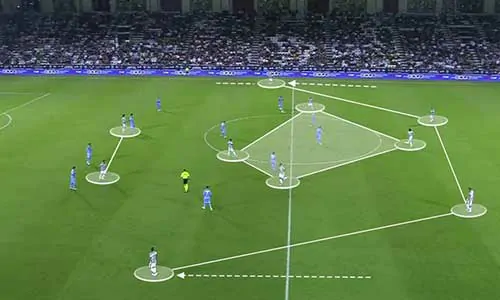
For example, a team might line up in a traditional 4-3-3 defensive shape. However, once they win the ball and begin their build-up play, one of the full-backs might tuck inside to act as a midfielder, while a central midfielder pushes higher up the pitch. This effectively transitions the shape into a 3-2-4-1 in possession. This highly fluid approach, which we will observe in high-level matchups at the FIFA World Cup 2026, allows teams to maximize passing lanes, overload specific areas of the pitch, and prevent counter-attacks by maintaining a secure “rest defense.”
This level of fluidity requires players to have an incredibly high tactical intelligence. Players must recognize visual cues, understand spatial relationships, and seamlessly swap positions with teammates. It is no longer about holding a static position; it is about controlling space dynamically.
How Modern Formations Will Shape the FIFA World Cup 2026
International football differs significantly from club football. While club managers have months to drill intricate tactical movements, national team managers must build competitive sides in just a few weeks of training camp. Therefore, at the FIFA World Cup 2026, we expect to see a fascinating blend of elite club-level tactics adapted into simpler, highly efficient international systems.
Managers must balance physical fatigue with tactical complexity. With the tournament featuring an expanded format, squad depth and tactical flexibility will be more critical than ever. We will likely see teams utilizing highly organized, compact mid-blocks out of possession to conserve energy, combined with explosive, fluid transitions when they win the ball. The ability to shift formations mid-game without making substitutions will be a decisive factor in determining who advances deep into the tournament.
Furthermore, the physical demands of playing in diverse climates and travel schedules mean that physical recovery and squad rotation will play a massive role. The coaches who can implement highly structured yet physically sustainable systems will have a clear advantage. Expect to see highly disciplined defensive blocks paired with rapid, direct counter-attacking systems designed to maximize efficiency.
Key Tactical Trends to Watch in the FIFA World Cup 2026
As we analyze the tactical battlefield of the next global tournament, several clear trends are emerging from top-tier club football that will undoubtedly influence international managers. These trends highlight how the modern game continues to prioritize control, structural flexibility, and physical intensity.
1. The Use of Inverted Full-Backs
Instead of running down the touchline to cross, modern full-backs increasingly tuck into the central midfield during build-up play. This creates a box midfield, providing numerical superiority in the center of the pitch and offering better protection against central counter-attacks. This trend will be highly visible among top-tier nations seeking to control games from deep areas.
2. Rest Defense and Counter-Pressing
Rest defense refers to the positioning of a team’s defensive players while their team is actually attacking. Modern managers design attacking structures specifically to prevent counter-attacks if possession is lost. By keeping a compact structure behind the ball, teams can instantly counter-press, winning the ball back high up the pitch before the opponent can transition.
3. The Sweeper-Keeper as an Out-of-Possession Defender
Goalkeepers are no longer just shot-stoppers; they are the first line of attack and the last line of defense. We will see goalkeepers playing highly active roles far outside their penalty box, acting as an extra passing option during build-up and quickly sweeping up long balls behind high defensive lines during the FIFA World Cup 2026.
Tactical Comparison Table
To help visualize these differences, here is a quick-reference guide comparing the primary formations discussed in this guide:
| Formation | Key Strength | Main Weakness | Ideal Player Profile |
|---|---|---|---|
| 4-4-2 | Simple structure, strong defensive banks | Easily outnumbered in central midfield | Hardworking box-to-box midfielders, traditional wingers |
| 4-3-3 | Possession control, passing triangles | Vulnerable to fast counters if pivot is isolated | Highly technical “single pivot”, creative interiors |
| 4-2-3-1 | Excellent balance, strong transitional shape | Can become isolated upfront if wingers drop too deep | Creative “Number 10” playmaker, disciplined double pivot |
| 3-5-2 | Strikers partnership, strong wing-back threat | Exposes wide defensive spaces if wing-backs get caught high | Ultra-fit wing-backs, versatile, mobile center-backs |
Frequently Asked Questions (FAQ)
Q1: What is the most successful formation in modern football?
There is no single “best” formation, as success depends entirely on player profiles and execution. However, the 4-3-3 and the 4-2-3-1 are currently the most popular setups at the elite level due to their inherent balance, dominance in midfield, and adaptability to fluid phase changes.
Q2: Why did teams stop playing the flat 4-4-2?
The primary reason was the battle for midfield supremacy. Modern formations like the 4-3-3 utilize three central midfielders, which consistently outnumbers the two-man midfield of a flat 4-4-2. This allowed opponents to easily dominate possession and control the tempo of the game.
Q3: What does “rest defense” mean in modern football tactics?
Rest defense refers to the defensive structure a team maintains while they are in possession of the ball. It involves positioning defenders and holding midfielders in a way that allows them to instantly disrupt opposition counter-attacks if possession is suddenly lost.
Q4: How does an inverted full-back work?
An inverted full-back is a defender who moves inside into the central midfield when their team has the ball, rather than overlapping down the flank. This helps create a midfield overload, improves possession retention, and provides central cover against counter-attacks.
Q5: Which formation is expected to dominate the FIFA World Cup 2026?
During the FIFA World Cup 2026, we expect to see highly flexible 3-4-3 and 4-2-3-1 variations dominate. Managers will likely prioritize defensive solidity and quick transitions to cope with the physical demands and limited preparation time of international tournaments.
Q6: How does the expanded format of the FIFA World Cup 2026 affect team tactics?
The expanded format of the FIFA World Cup 2026 means squads will face a potentially grueling schedule with more matches. Consequently, managers will rely heavily on squad rotation, compact mid-blocks to conserve energy, and versatile formations that can adapt without needing substitutions.
Conclusion: The Dynamic Future of Football Tactics
As we have explored, football tactics have evolved from rigid, highly specialized positions to a fluid, space-oriented game of chess. From the classic simplicity of the 4-4-2 to the complex, phase-shifting systems of today, tactical innovation continues to drive the sport forward. As the global stage is set for the highly anticipated FIFA World Cup 2026, the battle of tactical minds will undoubtedly take center stage, showcasing the pinnacle of modern football strategy.
Understanding these formations allows you to see the game through the eyes of the world’s greatest managers. Next time you watch a match, look beyond where the ball is and observe how players shift, adjust, and control the space around them.
To stay updated on the latest tactical analyses, team news, and strategic break-downs, explore the official FIFA website for tournament updates, and check out deep analytical breakdowns on Spielverlagerung tactical analysis.
Join the Tactical Discussion!
Which tactical system do you think will be the most effective at the FIFA World Cup 2026? Do you prefer the control of the 4-3-3 or the defensive solidity of three-at-the-back? Leave your thoughts in the comments below and share this guide with your fellow football fans!