FIFA World Cup Host Selection Process: Evolution Through the Years
FIFA World Cup Host Selection Process: Evolution Through the Years and the Road to FIFA World Cup 2026
The FIFA World Cup is the pinnacle of international football, drawing billions of viewers and generating massive economic and cultural impacts. The historic decision-making process behind the upcoming FIFA World Cup 2026 illustrates how dramatically the tournament has matured from its humble beginnings in the early 20th century. Over nearly a century, the method used to select host nations has evolved from informal agreements to highly complex, multi-billion-dollar global bidding processes.
To understand the magnitude of modern hosting campaigns, it is essential to trace this fascinating evolutionary path. This article explores how political shifts, commercial demands, and structural reforms have continuously reshaped the way FIFA selects the guardians of its crown jewel.
Table of Contents
- The Early Era of Host Selection (1930–1954)
- The Alternation Agreement and Continental Politics (1958–1998)
- The Era of Executive Committee Decisions (1998–2010)
- The Post-2015 Reforms: Transparency and Congress Voting
- Technical Requirements and Evaluation Criteria
- The Future of World Cup Hosting Beyond 2026
- Conclusion and Final Thoughts
- Frequently Asked Questions (FAQ)
The Early Era of Host Selection (1930–1954)
In the infancy of international football, the selection of a World Cup host was far less structured than the rigorous campaigns we observe today. During the late 1920s, FIFA sought to establish an independent tournament outside the Olympic Games. The selection of Uruguay to host the inaugural 1930 tournament was determined through a combination of sporting merit and financial promises.
Uruguay was the reigning double Olympic champion, but more importantly, the country offered to cover all travel and accommodation expenses for participating teams. Additionally, they committed to building a brand-new stadium, the Estadio Centenario. Consequently, the FIFA Congress selected Uruguay, despite protests from several European nations who refused to undertake the long maritime journey.
The subsequent tournaments in 1934 and 1938 highlighted the early political struggles of host selection. FIFA chose Italy to host in 1934 after intense lobbying by the Italian government. In 1938, the tournament was awarded to France. This decision sparked outrage in South America, where football associations believed the tournament should alternate strictly between Europe and the Americas. As a result, heavyweights like Argentina and Uruguay boycotted the French edition.
Following the devastation of the Second World War, the selection process focused primarily on reconstruction and feasibility. Brazil was chosen unopposed for the 1950 tournament because it was one of the few candidate nations with the infrastructure and economic stability to host. Similarly, Switzerland was chosen for 1954 because it was the home of FIFA and had remained neutral during the war, making it an ideal, unifying host.
The Alternation Agreement and Continental Politics (1958–1998)
As international travel became faster and safer, FIFA recognized the need to pacify regional confederations. To prevent boycotts and promote global harmony, an unwritten rotation agreement was established between Europe and South America. From 1958 until 1998, the tournament systematically bounced back and forth between these two dominant footballing continents.
This period also witnessed the growing influence of continental politics. For instance, the 1970 and 1986 tournaments in Mexico marked the emergence of the CONCACAF region as a viable host. Originally, Colombia had been chosen to host the 1986 edition, but severe economic difficulties forced them to resign. Mexico stepped in as a replacement, showcasing the importance of financial stability and existing infrastructure.
The Shift Toward Global Expansion and FIFA World Cup 2026 Precedents
While the FIFA World Cup 2026 is pioneering a 48-team framework, historical precedents of expanding the tournament always forced FIFA to reconsider its host selection criteria. The expansion to 24 teams in 1982 meant that fewer countries possessed the sheer number of high-capacity stadiums required to accommodate the event.
This reality became highly visible during the selection process for the 1994 World Cup. FIFA chose to award the tournament to the United States, defeating bids from Morocco and Brazil. The decision was controversial at the time because soccer was not a mainstream sport in the US. However, FIFA saw a massive commercial opportunity to expand the game into a highly lucrative market, establishing a precedent where commercial potential began to heavily influence host selection.
The Era of Executive Committee Decisions (1998–2010)
During the late 20th century, the ultimate power to choose the World Cup host was concentrated within the FIFA Executive Committee (ExCo). This was a small, elite group of 24 individuals representing the various continental confederations. This concentrated power structure led to highly competitive bidding wars, intense lobbying, and eventual controversy.
The bidding for the 2006 tournament became a flashpoint. South Africa was widely expected to win, but Germany secured the hosting rights by a single vote after an unexpected abstention. This controversial outcome prompted FIFA to temporarily introduce an official continental rotation policy to ensure that Africa would host its first-ever World Cup in 2010, followed by South America in 2014.
Lessons Learned Heading Into the FIFA World Cup 2026 Era
The continental rotation policy was quickly abandoned after the 2014 selection of Brazil, as it limited competition and reduced commercial leverage for FIFA. The ultimate crisis of the ExCo voting system occurred in December 2010. During a single session in Zurich, the Executive Committee simultaneously awarded the 2018 tournament to Russia and the 2022 tournament to Qatar.
The dual-award process triggered extensive international scrutiny, allegations of corruption, and multiple independent investigations. These systemic changes paved the way for a more open bidding ecosystem, leading directly to the structures governing the FIFA World Cup 2026 selection. It became clear that a small committee of 24 people could no longer decide the fate of the world’s largest sporting event behind closed doors.
The Post-2015 Reforms: Transparency and Congress Voting
Following the major institutional crisis of 2015, FIFA underwent a comprehensive restructuring program. The old Executive Committee was disbanded and replaced by the larger FIFA Council. More importantly, the power to select the World Cup host was officially stripped from this small executive group and transferred to the entire FIFA Congress.
Under the new rules, every single eligible member association of FIFA has one vote. Furthermore, the voting process is completely public, with each nation’s vote published immediately after the ballot. This reform drastically reduced the potential for backroom political deals and financial impropriety.
How Reform Enabled the Joint Bid for FIFA World Cup 2026
When the bidding phase for the FIFA World Cup 2026 officially opened, the entire methodology was subjected to unprecedented scrutiny. Bidders had to comply with strict, objectively graded technical requirements. Every aspect of a bid, including stadiums, transport, accommodation, and human rights, was assessed by an independent task force.
Ultimately, the publication of detailed technical evaluations ensured that the joint bid for the FIFA World Cup 2026 met all administrative thresholds. At the 68th FIFA Congress in Moscow, the “United Bid” of Canada, Mexico, and the United States defeated Morocco’s bid by a vote of 134 to 65. The transparency of this vote served as a powerful model of modern, accountable sports governance.
Technical Requirements and Evaluation Criteria
Hosting a modern World Cup requires astronomical investments and precise planning. Over the decades, the technical requirements have expanded from simply having a few decent football pitches to managing vast transportation networks, media facilities, and security operations.
Today, FIFA evaluates bids based on a rigorous points system divided into two main categories: Infrastructure (which accounts for 70% of the technical score) and Commercial/Financial viability (which accounts for 30%). Below is a comparative table highlighting how hosting criteria have shifted over different eras.
| Evaluation Era | Key Stadium Requirements | Key Infrastructure Focus | Decision-Making Body |
|---|---|---|---|
| Early Era (1930-1954) | 1 main high-capacity stadium; basic local pitches. | Basic hotel availability and rail connections. | FIFA Congress (informal lobbying). |
| ExCo Era (1998-2010) | 8-12 stadiums with 40,000+ seat capacities. | International airports, media centers, and fiber-optic networks. | Executive Committee (24 members voting secretly). |
| Modern Era (2026 Onward) | 16 stadiums with 40,000 to 80,000+ capacities. | Strict environmental sustainability, human rights standards, and massive transit. | Full FIFA Congress (public, transparent votes). |
In addition to these structural metrics, modern host nations must provide extensive legal guarantees. These include tax exemptions for FIFA, visa-free entry for ticket holders, and specialized intellectual property protection laws. These stringent demands have made hosting an elite privilege, often necessitating joint bids from multiple countries.
The Future of World Cup Hosting Beyond 2026
The cooperative blueprint established for the FIFA World Cup 2026 has already influenced subsequent decisions. With the tournament expanding to 48 teams and 104 matches, very few individual nations have the existing resources to host the entire event without risking severe post-tournament financial deficits.
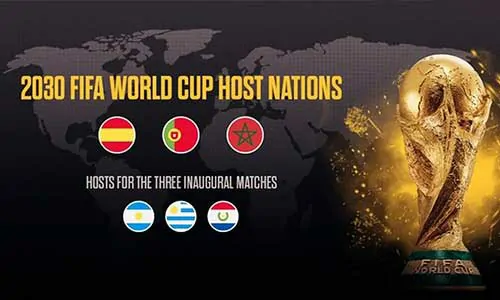
As football looks beyond the FIFA World Cup 2026, the necessity of multi-nation alliances is becoming increasingly obvious. For instance, the selection for the 2030 World Cup features a highly unique centenary celebration across six countries and three continents (Spain, Portugal, and Morocco as primary hosts, with celebratory matches in Uruguay, Argentina, and Paraguay). This trend demonstrates that collaborative hosting is no longer just a trend, but a necessity for sustainability.
Additionally, sustainability and climate change are playing critical roles in future selections. FIFA now demands detailed carbon-reduction strategies from bidding nations. By utilizing existing, world-class venues rather than constructing massive, short-lived “white elephant” stadiums, future hosts aim to align with global environmental goals.
Conclusion and Final Thoughts
From the modest voting halls of the 1930s to the massive electronic congresses of the FIFA World Cup 2026, the hosting selection process has evolved from an informal club decision into a highly audited, democratic, and transparent global campaign. These systematic reforms have restored a level of trust in the bidding process, ensuring that the privilege of hosting aligns with technical excellence, commercial viability, and social responsibility.
For football fans, this evolution ensures a safer, more sustainable, and highly organized tournament experience. As we eagerly anticipate the kickoff of the next great tournament, we can appreciate the immense organizational and ethical journey that brought the beautiful game to our global doorstep.
What are your thoughts on the new transparent voting process? Do you prefer single-nation hosts or joint multi-nation tournaments? Let us know in the comments below! For more detailed insights, feel free to visit the official FIFA Official Website and explore their comprehensive FIFA Publications archives.
Frequently Asked Questions (FAQ)
1. Why is the host selection for the FIFA World Cup 2026 considered historic?
The selection of the FIFA World Cup 2026 is historic because it was the first time that the entire FIFA Congress, rather than a select executive committee, voted on the host. It also marked the first time that a tournament was awarded to three co-hosts simultaneously under strict, transparent guidelines.
2. How did the voting process change after the 2015 FIFA reforms?
Prior to 2015, the host was decided via a secret ballot by the 24 members of the Executive Committee. After the reforms, the voting power was shifted to all eligible member associations (over 200 nations), and every single vote was made completely transparent and published for the public to see.
3. Why did FIFA abandon the continental rotation policy?
FIFA abandoned the strict continental rotation policy because it limited healthy competition among potential hosts. By restricting bids to a single continent, it reduced commercial leverage and did not guarantee that the most structurally qualified country would host the tournament.
4. Which countries will host the FIFA World Cup 2026?
The FIFA World Cup 2026 will be co-hosted by three North American countries: Canada, Mexico, and the United States. This represents the first time three nations have jointly hosted the tournament.
5. What are the key technical requirements for hosting the FIFA World Cup 2026?
For the FIFA World Cup 2026, bidders had to satisfy stringent criteria regarding stadium capacities (minimum 40,000 for standard matches, 80,000 for the opening and final), transport infrastructure, airport capacity, hotel availability, and strict human rights and environmental protection assessments.
6. How do multi-nation bids help with tournament sustainability?
Multi-nation bids allow countries to share the immense financial burden of hosting. By using existing, high-quality stadiums across multiple nations, it eliminates the need to build expensive new venues that might become useless after the tournament ends.